Will 2012 be the year for electronic dance music?
With dubstep artist Skrillex nabbing five Grammy Award nominations
and superstar DJ deadmau5 landing three, all indicators say yes.
“Skrillex is a purely electronic artist, and getting a
best-new-artist nomination is Grammy’s way of acknowledging the rise of
EDM (electronic dance music),” says Keith Caulfield, associate director
of charts at Billboard. The awards “have overlooked EDM artists
in the past, like David Guetta and Moby. Skrillex is the face of all EDM
at the Grammys.”
Who is Skrillex? With his eerie, spine-tingling samples and grinding
bass lines, 23-year-old Sonny Moore — a diminutive, bespectacled Los
Angeles-based DJ and producer — is the undeniable leader of dubstep.
“What makes this an incredible achievement is that he has been so
successful by being off the radar,” Caulfield says. “Sure, kids know who
he is, dance fans know him.” But when the awards show rolls around Feb.
12, “your average music fan won’t have the foggiest idea who he is.”
EDM is having its moment, says electronica pioneer Moby, who broke through to mainstream audiences in 1999 with album Play, which sold 3 million copies.
“For pop stars, their main currency is youth and the record label.
For rock stars, their currency is songwriting and their ability to play
live,” Moby says. “Electronic music artists are only as good as the last
record they played, and their ability to play other people’s records.
Luckily, there are a lot of good records out there.”
Last summer yielded a bumper crop of electronic dance festivals, from
Electric Daisy Carnival in Las Vegas, which pulled in 250,000
attendees, to Live Nation-backed IDentity, the first electronica touring
festival, which made 20 stops. Dozens more such fests are slated for
2012.
“If you go to a rock concert, there are four people standing onstage
playing songs that sound nice,” Moby says. “You go see Skrillex or
deadmau5 live, and there’s a huge production value, the lights, the
sound. It’s hard not to be impressed.”
The audience for such spectacles is almost certain to get bigger.
“Pop music has become so aggressively uptempo, when people go to
search for more of this kind of music, they’re discovering this whole
world that exists,” Caulfield says.

Showing posts with label Electronic dance music. Show all posts
Showing posts with label Electronic dance music. Show all posts

1/06/2012
Why Does America Love Skrillex?
In 2004, a 16-year-old named Sonny Moore left Los Angeles to play
guitar for a band called From First to Last. Somehow he wound up
becoming its lead singer instead. The group recorded for Epitaph
Records, played the Warped Tour, opened for Fall Out Boy. They were a
“scene” band, part of that realm of black-and-pink, mess-headed emo and
hardcore acts—a world that’s never entirely been embraced by the
mainstream rock press. Magazines might put a big name like My Chemical
Romance on the cover, for the copies it would sell; then they’d slink
back to arm’s-length joking about studded belts, Hot Topics, bad
haircuts, kid stuff, malls, commercial rock.

These days, Moore is a black-clad producer called Skrillex; vocal-cord problems helped steer him out of the singing game. He records electronic dance music, and is lately experiencing a pretty massive flush of notoriety—a storm of interest in his new EP, Bangarang, will surely extend. A month ago, he was nominated for five Grammys, including the one for Best New Artist. When Facebook counted the most-played pieces of music on the site in 2011, two of the top 10 were by Skrillex. Kanye West spent New Year’s Eve tweeting about him, including the allegation that his remix of Benny Benassi’s “Cinema” is “one of the greatest works of art ever made.” He draws massive crowds at festivals like the Electric Daisy Carnival in Las Vegas, where the Lollapalooza-sized attendance numbers positively dwarf those of rock fests you read about more often. His asymmetrical side-cut hair inspires blogs and novelty songs. The guy is rapidly becoming the face of something: a big American groundswell of love for buzzy, populist dance music.
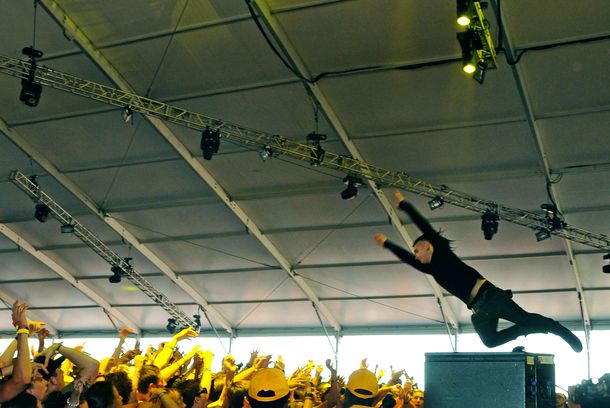
These days, Moore is a black-clad producer called Skrillex; vocal-cord problems helped steer him out of the singing game. He records electronic dance music, and is lately experiencing a pretty massive flush of notoriety—a storm of interest in his new EP, Bangarang, will surely extend. A month ago, he was nominated for five Grammys, including the one for Best New Artist. When Facebook counted the most-played pieces of music on the site in 2011, two of the top 10 were by Skrillex. Kanye West spent New Year’s Eve tweeting about him, including the allegation that his remix of Benny Benassi’s “Cinema” is “one of the greatest works of art ever made.” He draws massive crowds at festivals like the Electric Daisy Carnival in Las Vegas, where the Lollapalooza-sized attendance numbers positively dwarf those of rock fests you read about more often. His asymmetrical side-cut hair inspires blogs and novelty songs. The guy is rapidly becoming the face of something: a big American groundswell of love for buzzy, populist dance music.
You only have to look at the Billboard charts to notice
that Americans as a whole have taken to club sounds lately. As I type
this, our number-two song, “We Found Love,” has Rihanna singing over a
straight-up ecstatic house production by Calvin Harris. But there’s also
a deeper boom going on, one you can trace down from hit producers like
David Guetta and Swedish House Mafia to the huge rave-style events they
play in this country; and from there to big-tent, pop-minded acts like
Deadmau5, Aviici, and Kaskade; and from there to the way Skrillex can
pack tour dates in places like Montana; and from there to peers like
Bassnectar and 12th Planet. If these aren’t names that mean much to you,
well, it’s a bit like that rock scene again. Those who are in the
business of noticing what makes money move around the industry seem to
have plenty of eyes on this stuff; notice the Grammy nods for Skrillex.
Those who act as gatekeepers for musical artistry have been slightly
more standoffish about it.
One reason for this is that the acts we’re talking about are not,
generally speaking, interested in offering some refined or studious
advancement on the long, rich, soulful history of electronic dance
music. Skrillex’s work, in particular, is a lot more of a pile-up, as if
someone’s picked all the most obviously, superficially cool and
high-impact parts of a dozen different genres, dredged them in
stimulants, and started mashing them against one another—the same way
Quentin Tarantino can rifle through a dozen film genres and borrow all
the best fight scenes. There’s Daft Punk’s insistent pop-dance; the
blocky neon blips of electro; the melodic buzz of old video games; the
gushy, sentimental melodies of trance; the high-speed skip and glitch of
Aphex Twin; the glammy pop feel of L.A. party music—all things that are
easy to like. And when you mush them all together into one clanging,
high-octane stew, they become extremely easy to like, whether or
not the listener has ever known or cared about electronic music before.
Not elegant, deep, or moving, but very easy to get a thrill out of.
But the genre Skrillex milks the most is dubstep. If you wanted
to pick any one trick from this London genre that is super-obviously
cool, fresh, and head-turning, it would be the massive, grainy bass
blurts that have spun out of it, revved up by English producers like
Rusko—giant, wobbling shudders that go wubwubwub and activate the
same part of the brain that makes 10-year-old get excited about
explosions. You hear them everywhere now: in commercials for Transformers DVDs,
behind TV footage of extreme sports, folded into the bridges of pop
songs. The way Americans have made these basslines lately,
they’re aggressive, vertiginous, and adrenaline-heavy, and they conjure
up obviously cool images like being inside the gleaming metal torso of a
planet-sized robot while it punches an even bigger robot, or Cookie
Monster barfing up that liquid-metal Terminator from the sequel. They’re
littered throughout a lot of the tracks masses of Americans are
suddenly raving to. The cut that got Skrillex a Grammy nod for Best
Dance Recording is called “Scary Monsters and Nice Sprites”;
it crashes casually back and forth between glowy video-game melodies
and that big slobbery scenery-chewing dubstep grind. His remixes chew up
original songs in the same way, making the source material glitch and wubwub around itself. If those big bass drops are the car-chase scene, you typically do not have to wait long for him to cut to it.
Keep in mind that Americans, and especially American males, have traditionally had some weird reservations about electronic dance music—at
our worst, we’ve written the whole thing off as silly, trashy,
soulless, effeminate, or “gay.” And there is clearly something about
that gut-punch dubstep trick that can help certain Americans overcome
those reservations. For one thing, it sounds essentially like hard rock
or metal—a gnarly, monumental, distorted sound that tears through the
middle of the frequency spectrum. (If you’d like to hear evidence of
this, consult the nu-metal band Korn, who just released a “dubstep”
album, complete with contributions from Skrillex himself; those blurts
of bass slot easily into the space where the band would once have
deployed guitars.) In Skrillex’s hands, you can hear an odd, clear
continuity between the world of young hair-rock and emo acts and
hyperactive dance music. One of his remixes, for the Scottish band Twin Atlantic,
manages to swap out their instruments for a light-speed recreation of
old rave music, complete with vacuum-cleaner whooshes, sound-the-alarm
noises, and chewy wubwub. (There’s a slight kinship with hip-hop, too—the Bangarang EP
features an L.A. party rapper called Sirah, and people dancing to
Skrillex have a habit of moving their arms like they’re rapping to
Linkin Park songs.) It’s another species of that rare and lucrative
beast: A form of electronic dance music that does not threaten anyone’s
masculinity. Sort of like the last time electronic music threatened a
sales boom in the U.S., when one of the top successes was the Prodigy,
whose 1997 single “Firestarter” felt as aggro as anything else on offer.
Hence the new insult pointed at some of this American music:
“brostep.” The epithet comes complete with scary visions of amped-up
meatheads stomping around to the stuff—even if the actual audience is as
mixed-genre as any. You can probably guess how dubstep’s old English
guard has reacted to the stuff. Rusko, one of the first producers to
nudge the sound in this direction, has stepped back: “Brostep is sort of
my fault,” he told the BBC, “but now I’m starting to hate
it”—Americans, he said, were taking it too far, turning it into an arms
race of heaviness, draining the music of richness and subtlety. James
Blake, a highbrow British producer whose debut LP sounded more like an
elegant singer-songwriter’s, told the Boston Phoenix that the American scene had “hit upon a sort of frat-boy market where there’s this macho-ism
being reflected in the sounds.” (He suspected this would not appeal to
women, which I think misunderstands certain things about how both dance
music and gender work in America.) The word “soul” comes up a lot: This
American sound is all big, sick, melt-your-face-off noises, and no soul.
One doesn’t hear a lot of soul in an act like Skrillex; that’s
true. One doesn’t hear the long, sensual pacing of dance music,
either—his tracks surely get all that Facebook play because they shoot
straight for the three-minute flash and bang of a rock single, not the
elegant build and release of tension. But some of electronic music’s
biggest bursts of ideas have come from eras of populist face-melting.
Take, for instance, the original, early-90s heyday of British raves,
when thousands of kids—many of whom had never much cared about dance
music before—would flock to empty fields in search of relentless,
alarm-sounding music, and the process of trying to keep them excited
kept leading to the invention of fascinating sounds. (Even the epithet
“brostep” puts me in mind of a graceless, hard-pounding, and fairly
lovable techno from that era—“gabber,” which comes from a Dutch term
that means basically the same thing as “bro.”) When you have huge
numbers of people flocking to one spot with the agenda of getting messed
up and hearing something crushing and spectacular, the race to please
them stands a chance of rushing out on limbs and creating new things.
You don’t hear much of that in Skrillex, or among many of his peers; so
far, there’s just a lot of collisions and amplifications of sounds we’ve
already heard. But that’s what people said about our mess-headed emo
and hardcore scenes at the start of the century, and they rapidly became
their own weird world.
1/01/2012
deadmau5 to go all the way live in Las Vegas
For deadmau5, there's a world of difference between being a DJ and an electronic dance music (EDM) producer.


"If you want to be called an artist, then
you should produce your own music," says the 30-year-old Canadian, whose
real name is Joel Zimmerman. "EDM artists need to move away from being
human iPods."
If there's any question by now,
he prefers to be an electronic music artist. "If people come to a
deadmau5 show, I want them to hear deadmau5 music. Just like if I go to a
Motley Crue show, I don't want to hear them playing Warrant covers. An
artist just can't aspire to being the world's greatest player of other
people's music."
If that sounds a little
demanding, deadmau5 has the clout to be. Las Vegas Mayor Carolyn Goodman
has dubbed Jan. 2 "deadmau5 Day," which marks the beginning of the EDM
star's exclusive partnership with Wynn Las Vegas. Zimmerman, wearing one of his signature mouseheads, will burrow in Sin City through 2012, playing at XS and Encore nightclubs for an as-yet-undetermined number of shows.
If he can continue to attract crowds at mainstream and larger venues (he's done stadium shows in San Diego and Toronto), he stands to be the new face of EDM.
"The
thing about electronic music is that it's more about the music and
production than the individual," says electronica pioneer Moby.
"Generally, (EDM artists) are not the most distinctive-looking people.
They're nerdy guys who like to make music on their computers. deadmau5
has that very distinctive mouse head. And his shows have a big
production value."
He's also up for three Grammy Awards: dance/electronica album (4x4=12), dance recording (Raise Your Weapon, with Greta Svabo Bech) and remix (Foo Fighters' Rope). "I didn't even know that there were that many categories for EDM!" he says.
His
nominations weren't the only surprise. "Boom! Five nominations for (EDM
artist) Skrillex. His nominations are a win for us all."
More
important, what will he wear on the red carpet? "A couple of years ago,
I was nominated for a remix and wore a T-shirt that said, 'Your ad
here,' " he says with a laugh. "I'm going to do something like that,
fake ad, fake company kind of thing."
This
summer, deadmau5 became the first EDM artist to headline an all-genre
music festival when he topped the bill at Lollapalooza. 4x4=12 spent 54 weeks on Billboard's album chart and peaked at No. 2 on the dance/electronic chart, with 250,000 copies sold to date.
"EDM
is the new pop music. It's not just landing on the map, it's developing
and growing and being leached into the mainstream," he says. "But
that's just how it goes. It's the circle of life. Just because EDM has
become popular doesn't mean that it's going to suck, it just means more
people are listening to it."
12/30/2011
Electronic dance music hits its stride
Uptempo hits by the likes of Skrillex and deadmau5 make their mark on modern music

Will 2012 be the year for electronic dance music?
With dubstep artist Skrillex nabbing five Grammy Award nominations and superstar DJ deadmau5 landing three, all indicators say yes.
“Skrillex is a purely electronic artist, and getting a best-new-artist nomination is Grammy’s way of acknowledging the rise of EDM (electronic dance music),” says Keith Caulfield, associate director of charts at Billboard. The awards “have overlooked EDM artists in the past, like David Guetta and Moby. Skrillex is the face of all EDM at the Grammys.”
Who is Skrillex? With his eerie, spine-tingling samples and grinding bass lines, 23-year-old Sonny Moore — a diminutive, bespectacled Los Angeles-based DJ and producer — is the undeniable leader of dubstep.
“What makes this an incredible achievement is that he has been so successful by being off the radar,” Caulfield says. “Sure, kids know who he is, dance fans know him.” But when the awards show rolls around Feb. 12, “your average music fan won’t have the foggiest idea who he is.”
EDM is having its moment, says electronica pioneer Moby, who broke through to mainstream audiences in 1999 with album Play, which sold 3 million copies.
“For pop stars, their main currency is youth and the record label. For rock stars, their currency is songwriting and their ability to play live,” Moby says. “Electronic music artists are only as good as the last record they played, and their ability to play other people’s records. Luckily, there are a lot of good records out there.”
Last summer yielded a bumper crop of electronic dance festivals, from Electric Daisy Carnival in Las Vegas, which pulled in 250,000 attendees, to Live Nation-backed IDentity, the first electronica touring festival, which made 20 stops. Dozens more such fests are slated for 2012.
“If you go to a rock concert, there are four people standing onstage playing songs that sound nice,” Moby says. “You go see Skrillex or deadmau5 live, and there’s a huge production value, the lights, the sound. It’s hard not to be impressed.”
The audience for such spectacles is almost certain to get bigger.
“Pop music has become so aggressively uptempo, when people go to search for more of this kind of music, they’re discovering this whole world that exists,” Caulfield says.
12/28/2011
EDM’s Breakthrough Artists of 2011

2011 was a huge year for dance music. The dance music community saw a massive boom in interest, and the number of EDM fans–in America in particular–has spiked dramatically. This, of course, is great news for the community, and even better news for the artists. Many artists have emerged as some of the best in the game this year. Some of them were virtually unknown before 2011. Some of them were artists who were already established within the EDM community, but after a massive year in 2011, have achieved stadium status and mainstream popularity. Here is my list of the artists for whom 2011 served as a pivotal year in their journey to the top.
Deniz Koyu
When I first heard Deniz Koyu’s “Tung!” and “Hydra” this summer, there was no doubt in my mind that this man was going places. Sure enough, I was not alone in my sentiments, and 2011 saw some of the biggest names in the industry incorporating Koyu’s music into their sets. Later in the year, Koyu released his hits “Hydra” and his remix of James Blunt’s “Dangerous” with Johan Wedel, both of which were some of the most successful tracks of the fall 2011 season. Be on the lookout for big things in 2012 from Deniz Koyu.
Quintino & Sandro Silva
Both of these artists are, well, ‘epic’ in their own right, but when the two producers came together to create a track, they produced one of the biggest hits of the year. “Epic” is an absolute banger, winning the hearts of fans worldwide. It even got to #1 on the iTunes overall charts in Holland. Music festival Tomorrowland put out an after-movie of the festival that went viral, featuring many songs, including “Epic”. The song has certainly generated a lot of attention this year, and its success is a testament to the great artists who produced it.
Nervo
Nervo is Olivia and Miriam Nervo, twin models, DJs, and producers. The duo has achieved worldwide fame and success, with 2011 being a huge year for their musical careers. Along with venerated EDM artists Afrojack, Dimitri Vegas & Like Mike, they produced the official Tomorrowland anthem, “The Way We See The World,” and toured around the United States for Identity Festival this year.
Nicky Romero
Nicky Romero is starting to become a household name after a massive year in 2011. With hits like “Camorra”, “Bootcamp”, “Beta” with Hardwell, and most recently “Toulouse”, Romero is becoming one of the most popular acts in the EDM scene. His remix of Green Velvet’s “Flash” was heard in almost every prominent DJ’s sets at EDC this summer, and David Guetta cited him as the top breakout performer of 2011 when he was named #1 DJ in the world by DJ Mag’s annual poll.
Porter Robinson
Everyone’s favorite high school aged producer, Porter Robinson, had a huge year. He quickly skyrocketed to fame, and by early 2011, he was known as one of the biggest DJs in the world. He released a massive EP entitled “Spitfire”, and even accompanied music legend Tiesto on his College Invasion Tour, drawing in huge crowds. I expect that more huge things are on the horizon for this talented young producer.
Avicii
The Swedish sensation became one of the most beloved acts in dance music. At least one of his big room progressive house hits are heard in practically every major DJ set, and he is an absolute fan favorite. His song “Levels” is arguably the single biggest dance music song of 2011, and has been remixed by numerous artists; it was even sampled by Flo Rida for his song “Good Feeling.” Avicii is unstoppable.
Skrillex
Skillex is largely responsible for the popularization of dance music, and has helped to bridge the gap between dance music and the mainstream. Seemingly overnight, he went from relatively unknown to one of the world’s most popular artists in 2011. From my 12 year old sister, to seasoned veteran dance music fans, it seems as though everyone is a Skrillex fan. Skrillex recently received an unprecedented five Grammy nominations, a huge feat for a dance music artist. Skrillex is undoubtedly a pioneer, and has made valuable contributions to the world of music.
12/21/2011
Concert review: Skrillex at The Ritz Ybor, Ybor City
His masterful production and unrelenting performance made for a mind-melting spectacle this past Friday night; with video.
Skrillex's Friday night show at The Ritz Ybor selling out three-and-a-half months in advance probably signifies some sort of music apocalypse to some. How a whiny screamo star-turned-electronic dance music poster boy can do this and not, say, an artist who sings and plays a "real" instrument, seems blasphemously baffling.It probably doesn't help that he nabbed five Grammy nominations, a Spin cover, and a hefty handful of major radio station airplay all over the past few months. If there was anything resembling a massive revolution in popular American music this year, it was the burgeoning wave of dubstep-driven electronic dance music with Skrillex, board and all, surfing atop the whole damn thing.
Friday night wholly justified this sentiment. Entering the massive circus of fans ranging from shirtless muscley bros (a first time sight at the Ritz), to hyper-colored ballerinas, you could tell the main draw (besides the actual music) is the weird little subculture it's spawned.
The drugs, the costumes, the glowsticks, the sweaty camaraderie of it all; it's like entering a whole new neon reality far removed from every day life.
And that's before Skrillex even hit the stage. Flanked by two towering groups of pillars resembling a hybrid between the Emerald City and the set of Total Recall, Skrillex took the helm and didn't let go for a powerful 90 minutes.
For the most part, his catalogue relies heavily on remixes of other well-known tracks with a handful of his own (dude only has three EPs) thrown in for good measure. Tracks like his remix of Avicii's "Levels" or La Roux's "In for the Kill" all take a completely formulaic and predictable trajectory (what dubstep remixes don't?) but, goddamn, it's so hard not to get caught up in the Pavlovian response to the pulse-pounding energy of it all.
This married with the visual feast exploding around Skrillex's booth made for a pretty jaw-dropping spectacle. The massive screen behind it bounced from one visual to another with a C3PO-looking avatar popping up every once and a while. About halfway through the set, I realized this figure was mirroring all of Skrillex's movements by way of the tight Tron suit he was sporting. Can this be standard for, like, every DJ set, ever?
Not that he fell back on all the visual stuff. He puts on a show himself; calling out the crowd, bouncing back and forth, flailing with his godawful hairstyle like some maniacal primate. As one-dimensional as his music can sometimes be on record, live is a different story. House, dub, reggae, even a curveball verse from Biggie's "Hypnotize" and Fatman Scoop's "Be Faithful" made their way into the mix.
Coupled with a few unrecorded tracks and the more (read: insanely) popular ones like opener "Rock n' Roll (Will Take You to the Mountain)," "Scary Monsters and Nice Sprites" and his remix of Benny Benassi's "Cinema," the set showed a respectable amount of diversity and influence for a DJ who get such a one-note rep sometimes.
By the end, I left the Ritz much more impressed than I expected to be. Skrillex's masterful production and unrelenting performance made for a mind-melting spectacle that easily co-signed his worth as the top guy in the game right now. Here's to wishing Skrillex doesn't get to big for his designer britches and comes back to Ritz just once more before he explodes into superstardom.
Some video highlights from the show:
12/19/2011
MTV Counts Down Top 10 EDM Artists of 2011

It’s been a huge year for Electronic Dance Music (EDM). Artists such as David Guetta, Skrillex, Avicii, Swedish House Mafia, and Deadmau5 have become household names. EDM has become increasingly mainstream, and now MTV has recognized and honored some of the biggest names in EDM for their contributions to the world of music. When describing the new increasingly relevant role that EDM has come to play, MTV puts it best.
“Maybe you were at the grocery store when you found yourself singing along to Afrojack’s ‘Take Over Control’ for the hundredth time. Or maybe it was when Martin Solveig’s ‘Hello’ was suddenly on repeat on your iPod. Whatever your moment was, it’s fair to say the American appetite for electronic dance music surged in 2011, bringing ‘the rave’ to radio and festivals, touching every U.S. city (big and small). Even Grammy voters took notice this year, nominating Skrillex for Best New Artist and in four other categories.”
MTV put out the following list counting down the top 10 EDM artists of 2011. It seems pretty on point to me if we are speaking in terms of artists with the most widespread influence.
10. Martin Solveig
When Irv Gotti stopped by MTV News’ “RapFix Live” in October, he joked, “We’re just one record away from Kanye or Jay [being like]: [sings hook to Solveig's 'Hello'] ‘I just came to say hello — Hov!’ ” Gotti was kidding, but it’s true. Rap dudes beware: Songs like “Hello” and guys like Martin have seen such widespread success that the hip-hop industry, which has long enjoyed club and radio dominance, is shook.
In addition to being a technically superior producer and DJ, Solveig has also proven to the world that he has a sense of humor. His “Smash” video series — including “Hello,” “Initial S.H.E,” “Ready 2 Go” and “Big in Japan” — are some of the funniest and most well-produced clips of any genre. Kudos to Martin and his “manager” Lafaille for making us laugh and dance in 2011.
9. Tiësto
Veteran DJ/producer Tiësto might not be trance anymore, but judging by his popularity, fans don’t seem to care. How else do you set a record for the largest single DJ event — 26,000 fans attended his Carson, California, show — in U.S. history? T had hit collabos this year with Mark Knight, Hardwell, Diplo and, oh, Kanye West (sure, the Yeezy track hasn’t been released yet, but everyone’s heard it!). And if you can’t produce like Tiësto, at least now you can look like him: The EDM titan’s Club Life clothing line just hit select stores in New York and L.A.
8. Kaskade
Coming off a massive 2010 highlighted by Dynasty, Kaskade watched as his 2011 studio album, Fire & Ice, quickly became a staple in a healthy EDM diet. With features from Skrillex and Dada Life, and even vocals from rising star Skylar Grey, you’d be hard-pressed to find music lovers who couldn’t identify with or enjoy his breezy music in one way or another. The Illinois native pioneered the Identity Festival, which brought real-deal dance to America’s small cities. He also conquered Las Vegas’ day and nightlife and was named America’s Top DJ of 2011. Not a bad year for Mr. Ryan Raddon, not a bad year at all.
7. Calvin Harris
2011 was a marquee year for this Scotsman. Riding high on the success of Ready for the Weekend, Harris “Bounce”-ed and “Awooga”-ed with his adoring EDM fans the world over. He also infiltrated the mainstream by teaming up with Rihanna for a pair of hit collabos: the chart-topping “We Found Love” and “Where Have You Been.” As he gears up for his third studio album, Harris’ presence in EDM and pop culture is undeniable, and at this pace, he’ll be unstoppable in 2012.
6. Avicii
This year, Avicii underscored his place as dance music’s “Piano Man” (sorry, Bill Joel fans!). It started with “Blessed” (featuring Shermanology), continued with “Fade Into Darkness” (and Leona Lewis’ “Collide,” let’s be real) and capped off with the eagerly awaited release of “Levels.” Yes, Avicii’s keys and vocals went pop in ’11, and Flo Rida would certainly back us up on this as his Etta James vocal is sampled on Flo’s “Good Feeling.” To close out the year, Sweden’s Tim Bergling (stage names: Avicii, Tim Berg, Tom Hangs) is nominated for the Best Dance Recording Grammy with David Guetta for DG’s “Sunshine.” But before that Big Apple ball drops, Avicii will rock New York with a sold-out New Year’s Eve show.
5. Afrojack
Holland’s towering bleep-bender put on a spectacle of versatility in the past 12 months. Afro-beats scored monster mainstream U.S. radio singles for Beyoncé, Chris Brown and Pitbull. And then there’s his EDM game: Nearly a dozen collabos bearing his name charted in Beatport.com’s top 10, with Nervo, Steve Aoki, R3hab and Quintino onboard for a few. He wrapped up the year with a Grammy nom and the earth-shaking single “Lionheart,” and we can only pray he’ll deliver a video for it in ’12 … with a Jean-Claude Van Damme cameo.
4. Swedish House Mafia
Dubbed by MTV News as the “holy trinity of house music,” the rock stars of dance were everywhere this year, from “Miami 2 Ibiza,” Las Vegas to Brazil and all points in between. Not only did they succeed as a unified front, but Axwell, Steve Angello and Sebastian Ingrosso also soared as individual brands. And thanks to their Size, Axtone and Refune record labels, stellar acts like Thomas Gold, Swanky Tunes, Junior Sanchez, Third Party, Max Vangeli, AN21 and buzzworthy young rookie Alesso are on the verge of becoming household names. On the heels of a historic show at New York’s iconic Madison Square Garden this week, and a 2012 Grammy nod for “Save the World,” the Swedish Flag has been firmly planted in the American EDM soil.
3. deadmau5
“4×4=12″ cranked out hit after hit after hit. He nailed well over 100 live tour dates on the Meowingtons Hax Tour, earned RIAA gold with “Ghosts N Stuff” and headlined the traditionally all-rock Lollapalooza fest. Did we mention the wonder born Joel Zimmerman turned a skyscraper into a 4-D experience in London and bid farewell to a Playmate? I mean, who else can say they did that? The dude has balls N stuff.
2. David Guetta
David Guetta’s career has definitely gone pop this year — including the radio hits “Where Them Girls At” (featuring Nicki Minaj and Flo Rida) and “Without You” (featuring Usher) — but for EDM purists, his Nothing but the Beat had plenty to offer too, like stellar co-productions with Afrojack (“Lunar” and “The Future”) and Avicii (on the Grammy-nominated “Sunshine”). DJ Mag crowned Guetta the #1 DJ on the planet, and he headlined the world’s biggest festival’s, including Belgium’s Tomorrowland, Miami’s Ultra Music Festival and Las Vegas’ Electric Daisy Carnival. Guetta’s American Music Awards performance with Minaj seems to indicate that “Turn Me On” will be the next single from Nothing but the Beat, and fans can expect a shocking new video (and much more, we’re sure) early next year.
1. Skrillex
MTV’s EDM Artist of 2011 scored a whopping five Grammy nominations this year, including being the first DJ to land a Best New Artist nod. Indeed, Skrill’s musical background — both on his own and as a member of his former group, From First to Last — has carried over into his brand of fiery electronica. Skrillex has garnered an audience the world over that includes ravers, house heads and rockers alike. In today’s laptop generation of music, Skrillex is the new “rock.” From his remix of Benny Benassi and Gary Go’s “Cinema” to the recent Avicii pop song “Le7els” (not officially released yet), Skrillex dropped massive re-workings in ’11, in addition to his More Monsters and Sprites EP. He scored video games, produced records for Korn, launched his own OWSLA label and hit almost every major festival in the States, including Coachella and Lollapalooza. An exceptional catalog of releases coupled with an incessant touring schedule has made Skrillex the biggest EDM star of the year, and in 2012, he plans to tour 322 of the 365 days.
12/09/2011
How Genre Stereotypes Affect The Way We Experience Music

In the never-ending quest to maintain musical relevance, nu-metal band Korn recently came forward to declare that they invented dubstep. As a DJ and producer of dance music, it took me all of two seconds to determine that this declaration is nothing but a pitiful cry for attention from a band that is slipping out of the spotlight in a world where EDM (electronic dance music)–particularly dubstep–is slowly infiltrating popular culture and is beginning to generate a lot of attention.
Dubstep was actually invented in London in the late 1990′s as a derivative genre of 2-step garage, ‘reggae’ dub, UK grime, and drum and bass. It is deeply rooted in the underground, but has slowly made its way into the American mainstream. Early into the new millennium, dubstep hopped the pond and crossed over into America, and started developing on an underground level, unheard of by the majority of Americans until recently. In a short amount of time, dubstep in America went from being relatively unknown to one of the most popular and highly marketable genres of music. Artists such as Skrillex, Rusko, and Deadmau5 have become figureheads for the genre, and are now some of the most popular names in music. Skrillex is nominated for 5 Grammy Awards in this years Grammy’s, an unheard feat for an EDM artist. You can hear many of his songs in popular commercials, and even my 12-year-old sister blasts Skrillex on repeat.
Right now, dubstep is all the rage. But why? How did dubstep get so popular so fast, and why are artists like Korn so desperate to be associated with it? I believe its appeal is partially a result of the fact that like many other notorious genres throughout the history of music, it has a controversial reputation, the kind of reputation that makes parents concerned that it will negatively influence their children. Subsequently, this makes it very tempting for America’s youth to involve themselves with it. As transparent and sad as Korn’s attempt at linking themselves with dubstep was, I completely see the logic behind it. Dubstep is the next big thing.
As the world of music progresses, it seems as though a lot of the music that is most popular amongst America’s youth is periodically whatever genres parents consider to be the worst influence on their children at that time. This, in turn, leads many to rebel in an effort to find out what these genres are all about. The allure of the taboo is largely responsible for surges in popularity of “problem” genres such as metal, rap/hip-hop, and most recently, dance music. Each of these genres have their own perceived negative qualities that contribute to their unique and unfavorable reputations.
Parents feared that metal music would turn their children into satanic, drug-addicted misanthropes that would be forever lost.
Hip-hop and rap have been dirty words and banned in innumerable households for many years now, in fear that it will turn nice children into violent ‘dice-tossin’, ho pimpin’, bitch slappin’, drug slangin’, pot smokin’ hoodlums’, resulting in hoards of illegitimate children and run-ins with the law. I’m not just talking about contemporary hip-hop, flooded with references about pimped out vehicles, promiscuous sex, “stacks of cheddar”, and Hennessy. Hip-hop has had a negative reputation since its early days, back when it was more about poetic expression of life’s struggles than the pursuit of a materialistic lifestyle.
“In the end, regardless of the genre, music enriches our lives in a way nothing else can”
This isn’t just a contemporary thing either. Controversy has surrounded certain musical genres for nearly a century.
Jazz in the roaring 1920′s is said to have given birth to promiscuity.
Some of the older generations seem to have been deeply appalled by Elvis’ “suggestive” dance moves.
Also, who could forget Woodstock’s era of rock-and-roll? Woodstock is practically synonymous with sex and drugs.
The scandalous reputations of these genres didn’t push fans away. They just made these genres seem even more intriguing and thrilling, and rapidly attracted new fans who wanted to know what the buzz was all about.
Now in 2011, we revere artists like Jimi Hendrix, Bob Dylan, and The Grateful Dead. Elvis is practically a deity, forever immortalized for his contributions to music. Also, jazz is considered to be one of the most cultured forms of music. So what changed? Time and the progression of music.
Every time a new genre comes out that can be viewed as a bad influence, it is demonized. It seems like every time a new controversial genre surfaces, people seem to forget about how “bad” the older ones are.
There is little that drives a child to do something more than being told that it is bad or dangerous. Children listen to this music as a form of rebellion- it’s been that way since at least the 1920′s. Society has just changed its views on what it considers “problem” music to be over time, and it seems like every new genre tops the old ones. Just like russian dolls, old “trouble” genres are covered up by newer ones, and the focus shifts.
Growing up in Baltimore, I have a deep rooted love for hip-hop and rap. Up until the time I went to college, hip-hop consumed me. I played it loud and frequently, much to the dismay of my parents, who were worried about how negatively it would impact me and “corrupt” me. They believed listening to hip-hop would compromise my character and turn into a bad person, which consequently angered me and drove me to listen to it even more. But when they found out I had become involved with dance music to the point where I was a DJ and producer, they went into a full-fledged panic, catastrophizing about how it would ruin my life, because of what they had heard about EDM. They pleaded with me to stop being involved in dance music, hell, get back into hip-hop even. In their eyes, becoming involved with EDM was the worst thing that could have happened to me. But they have never been to a dance music event, and refuse to even listen to any of the music, so there is no real foundation behind their arguments. The only thing they have to go off of is what they have heard about EDM, a stereotype most frequently spread by people who have no concept of what the genre even entails. All they know is that dance music is now the new token bad reputation genre, and just like that, hip-hop is no longer a major concern.
Young people are most susceptible to getting drawn into these genres. Those who have yet to fully develop a strong sense of self are often curious, and more importantly, extremely impressionable. Dubstep is particularly appealing to them because not only is it a sub-genre umbrella-ed within the newest controversial genre, dance music, it is extremely hard-hitting, classified by an excessive amount of bass, screeching noises, and in many cases, a lack of melody. Some have dubbed dubstep a new, more electronic take on metal music. It evokes a similar response in which many dance to it wildly, stomping around and even forming mosh pits. This of course, is a rash stylistic over-generalization, as there are many different sub-genres of dubstep, but the elements I listed above are deemed some of the most critical core components of dubstep music. Combine the hard-hitting, angsty, aggressive sound with the controversy that comes from the fact that it is a form of dance music, and what you get is an audience that ranges from goths dressed in all black with 4 inch ear gauges, to thugged-out hip-hop fans (there is a strong correlation between hip-hop and dubstep, as many dubstep artists started in hip-hop, and many dubstep songs feature rap vocals), to frat bros, to prepubescent, bright-eyed teeny boppers. The appeal of the genre is extremely wide, and attracts different demographics for different reasons, which is a big reason why dubstep has enjoyed a meteoric rise to popularity, and has become successful so fast.
I believe that genres with bad reputations are often falsely represented and misunderstood. I feel that no genre of music is inherently “bad” or a “negative influence”, but I do believe they can be capable of leading people astray if they are not involved with the music for the right reasons. Lots of people like to say that dance music is about drugs, sex, and hedonistic irresponsible decisions. But as somebody who has devoted myself fully to dance music, I feel that I am qualified to say that that is not an accurate representation of what dance music is truly about. My parents feared that dance music would turn me into a careless person who would spend all my time partying. That sentiment could not be farther from the truth. In fact, I actually started going out a lot less when I became a DJ and producer, because I preferred to stay in and work on mixes and make tracks. It may sound cool and glamorous, but really it just means I like to play around on software and gear all day. That’s right–people expect DJs to be party animals and overall wild people, but in reality, all I am is a glorified tech and computer nerd.
The point I am trying to make is, musical genres, just like anything else in life, are what you make of them. The best advice I can give is to be interested in the types of music you are passionate about because you genuinely love and appreciate them. Many of the stereotypes about these genres are inaccurate and should not form your opinion solely based on them. That being said, there is, unfortunately, some level of validity to those stereotypes. There is nothing that devastates me more than reading headlines about drug related incidents at raves, not only because it is sad, but also because it perpetuates all the negative stereotypes about the genre, and gives young impressionable fans the idea that this is the kind of behavior that accompanies being a part of the scene. It is unfortunate that incidents like this occur, because they are not an accurate representation of what the scene actually stands for, and the negative vastly overshadows the positive.
Just like young teenagers should not be out at bars and nightclubs, they should not be out at raves and shows, and that’s the bottom line. The music itself is not an issue; the concerns arise when impressionable young people who are not developed enough to make informed decisions get mixed up in adult nightlife settings. Being a part of the EDM community doesn’t mean you have to or should attend festivals or raves. In the end, it should just be about the music. Dance music, just like all other genres of music, is meant to be appreciated for what it is, and can actually be a very positive musical experience for fans young and old. The digital nature of dance music allows people to create it right from their computers, expanding creative possibilities. More than a few established EDM artists got their start by just making music in their bedroom on their computer. That’s what so beautiful about it- you don’t need fancy equipment, a studio, or lots of money to create great work.
Music is one of the greatest gifts the world has to offer. It inspires us, helps us through tough times, and pushes us to new levels of creativity and achievement. It’s a universal language that everyone understands. In the end, regardless of the genre, music enriches our lives in a way nothing else can.
Getting To Know: ALPHA DATA

With electronic music permeating mainstream consciousness, 26-year-old James Ristvedt, aka Alpha Data, is looking to bring his unique brand of EDM to as many raging dance floors as he can.
Under the tutelage of Disco Biscuits bassist Marc Brownstein, who manages and guides Ristvedt as he progresses through the treacherous world of up-and-coming artists, he plans to continue to take life and his career one day at a time while making music he loves.
Only performing under his current moniker since August due to trademark concerns with his previous stagename, Ristvedt has already amassed an impressive following and risen through the online glitch-hop charts.
The Minneapolis native has plans to share the stage with The Disco Biscuits over their New Year’s run in both New York City and Chicago and open for Conspirator on their winter tour.
We caught up with Ristvedt to discuss everything from what sets him apart from other artists to his on-stage demeanor and working with Brownie to Skrillex’s five Grammy nominations.
--
YOUR SOUND
In one sentence, describe what Alpha Data is all about.
 Bass-heavy dance music with huge drums, catchy melodies and intricate layering.
What’s your musical background?
I grew up playing trumpet in concert band, jazz band, pep band – pretty much anything in school where they allowed you to play music really loudly, I was involved.
In high school, I was really big into punk rock. Some friends and I formed a band together where I was actually the lead singer. However, around the time I was 15 or so, I started producing electronic music using a program called Fruity Loops.
[FOLLOW Alpha Data on Facebook.]
Around the time I went to college, I started playing bass guitar and getting more interested in the low end of music. By the time I graduated, I had begun making electronic music with a heavy focus on bass.
While some of my experiences certainly influence my music more than others, I like to think they’ve all played some part in shaping my musical identity.
 While
some of my experiences certainly influence my music more than others, I
like to think they’ve all played some part in shaping my musical
identity.
While
some of my experiences certainly influence my music more than others, I
like to think they’ve all played some part in shaping my musical
identity.
Describe your sound and what makes it unique.
I tend to write tracks with a lot of layers. What this means, practically, is that while there’s usually an ample amount of bass and drums to get people dancing, there’s enough by way of melody and textural effects that the music can also be very enjoyable to listen to on headphones sitting at your desk.
What makes your brand of electronic music particularly enjoyable?
It’s fun. It’s got a bounce to it. It’s got a swagger to it. It’s something that people don’t necessarily hear on a daily basis, but still has some modicum of familiarity to it.
Explain what the genre of “glitch-hop” means to you.
Glitch-hop, laser bass, aqua crunk, or whatever you want to call it, has so many different definitions and descriptions that are attributed to it.
To me, glitch-hop is about using sounds and techniques that might not normally be found in music in a way that creates danceable beats with a groove.
What are some of your inspirations besides The Disco Biscuits?
Tipper, Opiuo, Love and Light, Samples and Knight Riderz. All of them are making some of the greatest music on the planet right now.
Who are your non-producer or non-electronic influences?
 Some
of my biggest influence comes from videogames – new and old. I grew up
playing games like “Contra,” “ToeJam and Earl”and “Chrono Trigger.”
Some
of my biggest influence comes from videogames – new and old. I grew up
playing games like “Contra,” “ToeJam and Earl”and “Chrono Trigger.”These games all have really great soundtracks, and in some ways, really helped to make me appreciate music more. At some point I plan to do an entire EP based around videogame music that inspired me when I was younger.
Minneapolis isn’t necessarily known as a hub for electronic music. How did you first get into the scene and how does your upbringing affect your sound?
Minneapolis actually has a humungous dubstep scene, which I think surprises a lot of people. I basically got into the Minneapolis EDM scene through friends who were playing and listening to dubstep. After I started playing shows, I was able to get some gigs opening up for some great national and international acts.
Luckily, this area has some really talented producers who have really helped me to develop my sound. I think more than anything, being surrounded by so much bass music serves as constant inspiration for me.
What’s your nightly goal when you’re playing a gig?
Honestly, my biggest goal is to have fun. I know that sounds really cliché and such a politician answer, but it’s absolutely true. The primary reason I make the music I make is because I enjoy the music I make.
Getting to hear tracks that I spent weeks toiling over blasted out of a gigantic system is an incredible feeling. I like to have fun on stage and try not to take myself too seriously.
As far as what kind of reaction I want from crowds, I really just want people to have the best night ever, every single night.
I think it’s a reciprocal thing. The more fun I have, the more fun it is to watch me, so the crowd has more fun, which means I have more fun. It’s like a carousel. It goes up and down, and around.
ON THE ROAD
What are you working on right now?
Right now I’m working on new originals, new remixes and constantly working on more and more exposure. I’m playing the Disco Biscuits’ after-party on December 27 in New York City with Tipper and Orchard Lounge, and playing with The Biscuits on New Year’s Eve in Chicago.
I have an EP that just came out called “Nefertiti” (which is currently number 3 on the Beatport Glitch-Hop chart). Next year is going to be pretty much constant work and a lot of fun.
How did you hook up with Marc Brownstein?
Marc and I had been talking for a while on Facebook, and I’d sent him some of my tracks to listen to. I honestly didn’t expect more of a response than, “Cool man, sounds good,” or some other polite-but-uninterested answer.
 To
my surprise, he sent back within just a few minutes and told me he
really liked the tracks and that I should send more. Over the next few
weeks we talked more and he told me that he was interested in helping my
career.
To
my surprise, he sent back within just a few minutes and told me he
really liked the tracks and that I should send more. Over the next few
weeks we talked more and he told me that he was interested in helping my
career.[BUY tickets to The Disco Biscuits' New Year's Eve run on their website.]
He said that if I would give him the opportunity, he’d like to manage me, and use his knowledge of the music industry to help me in any way he could. We’ve been working together ever since.
How has he helped you get started?
He’s helped me book some really mind-blowing shows. Playing on the same stage as The Disco Biscuits at all would be an honor for me, but playing on the biggest night of the year is beyond words.
He’s also helped me get connected with some really great musicians. I’d say most importantly, he knows a lot about this business that I know nothing about, and he’s been great in that sense. He also routinely gives me feedback on new tracks. I honestly could not ask for a better manager.
What kind of technology do you use on stage?
Right now I’ve got a fairly limited set-up as far as live performers go. I’m running Ableton Live on my MacBook Pro and I use an Akai APC40 MIDI controller.
A lot of people have more elaborate set-ups, but for what I’m doing right now, it is the perfect amount of equipment to use, and it makes it really easy for me to travel.
With software available to everyone, what sets you apart from everyone else in both tangible and intangible ways?
I think more than anything it’s my perspective. I think I have a pretty unique perspective on music, so I offer a lot of listeners a sound that they can’t find in most places.
I have a constant drive to improve myself and make every track I produce better than the previous track.
[LISTEN to Alpha Data's music on SoundCloud.]
I’m currently halfway through my final year of law school, and I’ve managed to balance producing music and reading casebooks pretty well for the last three years.
Overall, I think I’ve just got an easygoing personality. I’ve been incredibly lucky to have the good fortune I’ve had thus far, and I like to try and stay humble about everything. Oh, and I love telling jokes. Especially extremely long jokes. If you ever see me at a show and want to hear a good joke, ask me. But be prepared to stand around for five minutes listening.
Skrillex just got 5 Grammy nods, Britney Spears is incorporating dubstep into her songs – what do you think of where electronic music is headed?
I think it represents a really phenomenal opportunity for EDM. It shows that more and more people are broadening their horizons and listening to music that in the past would have been condemned, as Hank Hill so eloquently put it, as “toilet sounds.”
As far as where it’s headed, I’m not really sure. People seem to be very worried about the notion of EDM “selling out,” or becoming too mainstream.
Regardless of whether or not that’s a feasible possibility, I think that as long as there are artists out there who are willing to push musical boundaries and try new things, it will continue to be a great time to be a fan of music for the foreseeable future.
Where do you see yourselves in 1 year? 2 years? 5 years? 10 years?
Celebrating the five-year anniversary of you asking me this question. I’ve wanted to use that line since the first time I ever heard Mitch Hedberg, and this is honestly the first chance I’ve ever gotten, so thank you for that.
 As
far as my Nostradamus predictions: I try not to get lost in thinking
about the future too much. There’s so much that’s impossible to predict,
and the present is way too much fun to spend any time being anywhere
else.
As
far as my Nostradamus predictions: I try not to get lost in thinking
about the future too much. There’s so much that’s impossible to predict,
and the present is way too much fun to spend any time being anywhere
else.I guess my biggest hope for the future is that I continue to maintain some success, am able to keep making music and, ideally, have that music bring some happiness into the lives of others.
Two years ago I went to see the Disco Biscuits in Chicago on Halloween. They played at an absolutely beautiful venue called the Auditorium Theatre. I walked in and looked around, thinking, “These are the luckiest guys on the planet. They get to play in this incredible place, playing music they love, for thousands of people. I will never know that feeling.”
In a few weeks, I’ll be playing in that venue . . . with that band . . . on the biggest night of the year. Two years ago, this was something that was not even in the realm of possibilities for me in any way.
Now that this is a reality, I plan on spending every possible waking moment being thankful for how lucky I am and soaking it in.
--
Catch Alpha Data after The Disco Biscuits at the Best Buy Theater in New York City on December 27 at the after-party with Tipper and Orchard Lounge and playing set breaks at the Auditorium Theater in Chicago for New Year's Eve. He will also join Conspirator for their winter tour in 2012.
Subscribe to:
Posts (Atom)
