Showing posts with label United States. Show all posts

1/06/2012

Why Does America Love Skrillex?

In 2004, a 16-year-old named Sonny Moore left Los Angeles to play guitar for a band called From First to Last. Somehow he wound up becoming its lead singer instead. The group recorded for Epitaph Records, played the Warped Tour, opened for Fall Out Boy. They were a “scene” band, part of that realm of black-and-pink, mess-headed emo and hardcore acts—a world that’s never entirely been embraced by the mainstream rock press. Magazines might put a big name like My Chemical Romance on the cover, for the copies it would sell; then they’d slink back to arm’s-length joking about studded belts, Hot Topics, bad haircuts, kid stuff, malls, commercial rock.


These days, Moore is a black-clad producer called Skrillex; vocal-cord problems helped steer him out of the singing game. He records electronic dance music, and is lately experiencing a pretty massive flush of notoriety—a storm of interest in his new EP, Bangarang, will surely extend. A month ago, he was nominated for five Grammys, including the one for Best New Artist. When Facebook counted the most-played pieces of music on the site in 2011, two of the top 10 were by Skrillex. Kanye West spent New Year’s Eve tweeting about him, including the allegation that his remix of Benny Benassi’s “Cinema” is “one of the greatest works of art ever made.” He draws massive crowds at festivals like the Electric Daisy Carnival in Las Vegas, where the Lollapalooza-sized attendance numbers positively dwarf those of rock fests you read about more often. His asymmetrical side-cut hair inspires blogs and novelty songs. The guy is rapidly becoming the face of something: a big American groundswell of love for buzzy, populist dance music.
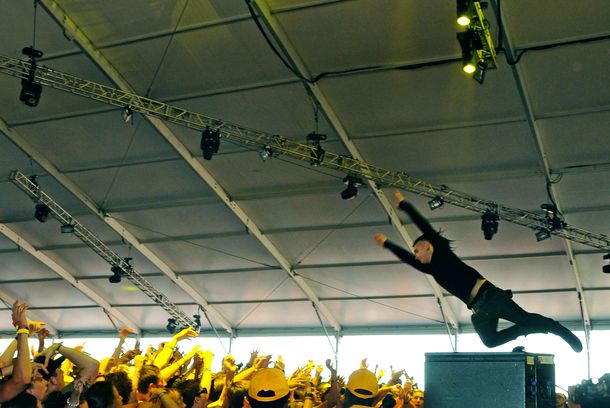
You only have to look at the Billboard charts to notice that Americans as a whole have taken to club sounds lately. As I type this, our number-two song, “We Found Love,” has Rihanna singing over a straight-up ecstatic house production by Calvin Harris. But there’s also a deeper boom going on, one you can trace down from hit producers like David Guetta and Swedish House Mafia to the huge rave-style events they play in this country; and from there to big-tent, pop-minded acts like Deadmau5, Aviici, and Kaskade; and from there to the way Skrillex can pack tour dates in places like Montana; and from there to peers like Bassnectar and 12th Planet. If these aren’t names that mean much to you, well, it’s a bit like that rock scene again. Those who are in the business of noticing what makes money move around the industry seem to have plenty of eyes on this stuff; notice the Grammy nods for Skrillex. Those who act as gatekeepers for musical artistry have been slightly more standoffish about it.

One reason for this is that the acts we’re talking about are not, generally speaking, interested in offering some refined or studious advancement on the long, rich, soulful history of electronic dance music. Skrillex’s work, in particular, is a lot more of a pile-up, as if someone’s picked all the most obviously, superficially cool and high-impact parts of a dozen different genres, dredged them in stimulants, and started mashing them against one another—the same way Quentin Tarantino can rifle through a dozen film genres and borrow all the best fight scenes. There’s Daft Punk’s insistent pop-dance; the blocky neon blips of electro; the melodic buzz of old video games; the gushy, sentimental melodies of trance; the high-speed skip and glitch of Aphex Twin; the glammy pop feel of L.A. party music—all things that are easy to like. And when you mush them all together into one clanging, high-octane stew, they become extremely easy to like, whether or not the listener has ever known or cared about electronic music before. Not elegant, deep, or moving, but very easy to get a thrill out of.

But the genre Skrillex milks the most is dubstep. If you wanted to pick any one trick from this London genre that is super-obviously cool, fresh, and head-turning, it would be the massive, grainy bass blurts that have spun out of it, revved up by English producers like Rusko—giant, wobbling shudders that go wubwubwub and activate the same part of the brain that makes 10-year-old get excited about explosions. You hear them everywhere now: in commercials for Transformers DVDs, behind TV footage of extreme sports, folded into the bridges of pop songs. The way Americans have made these basslines lately, they’re aggressive, vertiginous, and adrenaline-heavy, and they conjure up obviously cool images like being inside the gleaming metal torso of a planet-sized robot while it punches an even bigger robot, or Cookie Monster barfing up that liquid-metal Terminator from the sequel. They’re littered throughout a lot of the tracks masses of Americans are suddenly raving to. The cut that got Skrillex a Grammy nod for Best Dance Recording is called “Scary Monsters and Nice Sprites”; it crashes casually back and forth between glowy video-game melodies and that big slobbery scenery-chewing dubstep grind. His remixes chew up original songs in the same way, making the source material glitch and wubwub around itself. If those big bass drops are the car-chase scene, you typically do not have to wait long for him to cut to it.

Keep in mind that Americans, and especially American males, have traditionally had some weird reservations about electronic dance music—at our worst, we’ve written the whole thing off as silly, trashy, soulless, effeminate, or “gay.” And there is clearly something about that gut-punch dubstep trick that can help certain Americans overcome those reservations. For one thing, it sounds essentially like hard rock or metal—a gnarly, monumental, distorted sound that tears through the middle of the frequency spectrum. (If you’d like to hear evidence of this, consult the nu-metal band Korn, who just released a “dubstep” album, complete with contributions from Skrillex himself; those blurts of bass slot easily into the space where the band would once have deployed guitars.) In Skrillex’s hands, you can hear an odd, clear continuity between the world of young hair-rock and emo acts and hyperactive dance music. One of his remixes, for the Scottish band Twin Atlantic, manages to swap out their instruments for a light-speed recreation of old rave music, complete with vacuum-cleaner whooshes, sound-the-alarm noises, and chewy wubwub. (There’s a slight kinship with hip-hop, too—the Bangarang EP features an L.A. party rapper called Sirah, and people dancing to Skrillex have a habit of moving their arms like they’re rapping to Linkin Park songs.) It’s another species of that rare and lucrative beast: A form of electronic dance music that does not threaten anyone’s masculinity. Sort of like the last time electronic music threatened a sales boom in the U.S., when one of the top successes was the Prodigy, whose 1997 single “Firestarter” felt as aggro as anything else on offer.

Hence the new insult pointed at some of this American music: “brostep.” The epithet comes complete with scary visions of amped-up meatheads stomping around to the stuff—even if the actual audience is as mixed-genre as any. You can probably guess how dubstep’s old English guard has reacted to the stuff. Rusko, one of the first producers to nudge the sound in this direction, has stepped back: “Brostep is sort of my fault,” he told the BBC, “but now I’m starting to hate it”—Americans, he said, were taking it too far, turning it into an arms race of heaviness, draining the music of richness and subtlety. James Blake, a highbrow British producer whose debut LP sounded more like an elegant singer-songwriter’s, told the Boston Phoenix that the American scene had “hit upon a sort of frat-boy market where there’s this macho-ism being reflected in the sounds.” (He suspected this would not appeal to women, which I think misunderstands certain things about how both dance music and gender work in America.) The word “soul” comes up a lot: This American sound is all big, sick, melt-your-face-off noises, and no soul.

One doesn’t hear a lot of soul in an act like Skrillex; that’s true. One doesn’t hear the long, sensual pacing of dance music, either—his tracks surely get all that Facebook play because they shoot straight for the three-minute flash and bang of a rock single, not the elegant build and release of tension. But some of electronic music’s biggest bursts of ideas have come from eras of populist face-melting. Take, for instance, the original, early-90s heyday of British raves, when thousands of kids—many of whom had never much cared about dance music before—would flock to empty fields in search of relentless, alarm-sounding music, and the process of trying to keep them excited kept leading to the invention of fascinating sounds. (Even the epithet “brostep” puts me in mind of a graceless, hard-pounding, and fairly lovable techno from that era—“gabber,” which comes from a Dutch term that means basically the same thing as “bro.”) When you have huge numbers of people flocking to one spot with the agenda of getting messed up and hearing something crushing and spectacular, the race to please them stands a chance of rushing out on limbs and creating new things. You don’t hear much of that in Skrillex, or among many of his peers; so far, there’s just a lot of collisions and amplifications of sounds we’ve already heard. But that’s what people said about our mess-headed emo and hardcore scenes at the start of the century, and they rapidly became their own weird world.

Skrillex - Bangarang Lyrics

(Guitar Intro)

Shout to all my boss boys
Sha-sha-sha-sha-sha-sha-shout to all my boss boys
We rowdy
Shout to all my boss boys
Sha-sha-sha-sha-sha-sha-shout to all my boss boys
We rowdy
Shout to all my boss boys
Sha-sha-sha-sha-sha-sha-shout to all my boss boys
We rowdy
Shout to all my boss boys
Sha-sha-sha-sha-sha-sha-shout to all my boss boys

BANGARANG! Peace! BAYYYH!
Wah-wa-wa-Wah-wa-wa-BANG-BANG
O-ooo-ooo-ooo-o-ooo-ooo-wa, Feel the BAYYYH!
Wah-wa-wa-Wah-wa-wa-BANG-BANG
O-ooo-ooo-ooo-o-ooo-ooo-wa, BANGARANG!
BAYYYH! Wah-wa-wa-Wah-wa-wa,
BANG BANG, o-ooo-ooo-ooo-o-ooo-ooo-wa FEEL BASS!
BAYYYH! Wah-wa-wa-Wah-wa-wa,
BANG BANG, o-ooo-ooo-ooo-o-ooo-ooo-wa BANGARANG!
BAYYYH! Wah-wa-wa-Wah-wa-wa,
BANG BANG, o-ooo-ooo-ooo-o-ooo-ooo-wa FEEL THE
BAYYYH! Wah-wa-wa-Wah-wa-wa,
BANG BANG, o-ooo-ooo-ooo-o-ooo-ooo-wa BANGARANG!
BAYYYH! Wah-wa-wa-Wah-wa-wa,
BANG BANG, o-ooo-ooo-ooo-o-ooo-ooo-wa FEEL BASS!

BAYYYH! Boss boys, sha-sha-sha-sha-sha-sha-
Shout to my boos boys
We rowdy
Shout to all my boss boys,
Sho-sho-sho-sho-sho-sho-shout to all my boss boys BANGARANG!
Shout to all my boss boys,
Sho-sho-sho-sho-sho-sho-shout to all my boss boys
We rowdy
Shout to all my boss boys
Sho-sho-sho-sho-sho-sho, BAYYH, BAYYYH, BANGARANG! BASS!
Wah-wah-ooo-wah, berm-berm-berm-mmm-berm-berm-berm!
Wah-wah-ooo-wah, berm-berm-berm-berm-WOOO!
Wah-wah-ooo-wah, berm-berm-berm-mmm-berm-berm-berm!
Wah-ooo-ooo-woo-yuuuh, FEEL THE
Wah-wah-ooo-wah, berm-berm-berm-mmm-berm-berm-berm!
Wah-wah-ooo-wah, berm-berm-berm-berm-WOOO!
Wah-wah-ooo-wah, berm-berm-berm-mmm-berm-berm-berm!
Wah-ooo-ooo-woo-yuuuh, FEEL THE
Wah-wooo-wah, berm, berm berm, berberber, berm, berm,
Wah-wooo-wah-wah-wah-wah-WOOO!
Wah-wooo-wah, berm, berm berm, berberber, berm, berm,
Wah-ooo-ooo-woo-yuuuh, FEEL THE

1/04/2012

BBC Talk To Skrillex In LA

The Beeb head to Los Angeles to interview Sonny Moore aka Skrillex in his creative environment at home.

1/02/2012

HARD's Gary Richards Captains One Holy Ship!


For the past half decade L.A.'s HARDfest brand has been behind some of the most riotously wondrous shows on the West Coast and beyond. Now the electronic music events activator is taking to the sea with a few dozen of its very favorite racket-makers, among them Fatboy Slim, A-Trak, Diplo and Skrillex. The voyage is called HOLY SHIP!, and it kicks off Thursday night at Revolution Live. Niteside got with HARD's Gary Richards and had him fill us in on all the action.

What the hell's a Holy Ship and why should we ship out on it? People know us for the HARD Summer and HARD Haunted Mansion festivals, and for a few years I've had the idea of doing a HARD Cruise. Take the acts I book at the festivals -- i.e. Diplo and Skrillex and a lot of the up-and-comers -- and use a giant cruise ship as the venue for the festival.

The name HOLY SHIP! started as a joke, but we all grew to love it. Europeans know that MSC (based out of Italy) is one of the top five cruise fleets in the world, and the Poesia is one of their largest ships. It has a tennis court and gym and spa and sushi bar and the list goes on.  When you really educate people with what we're doing in music and vacation, their eyes pop out of their head. That's why the name HOLY SHIP! just fits.

Who have you got to top this maiden voyage? One of my all-time favorite musicians in the world, Fatboy Slim, is a big draw for me and anyone that partied over the years. Diplo and A-Trak are like the two guys that have really been HARD superstars since early on. I like that you have kids in college or whatever just finding out about them now because they fell in love with a Major Lazer song or a Duck Sauce song; then they come and see these guys in front of an audience. As a DJ, they just own it. A-Trak and Steve Aoki and a few others (Jason Bentley, Gina Turner, Rory Phillips) were all at my first HARD event ever in 2007. That was a crazy night, and right now I feel like I did right before that, like this party is going to be insane.

We also have Rusko, who I first brought to the states in 2009 for his live USA debut.  He's known for really launching dubstep, and I've toured with  him around the country. He's such an awesome performer. Then I got a little lucky with Skrillex. When I started hanging with Sonny a year or so ago, he was really excited that deadmau5 had even listened to his song, nevertheless that he was going to put it out on his label Mau5trap. He told me then he'd been in the audience at my show at HARD Haunted Mansion and always wanted to play it. We made that happen this October, and now Skrillex is like the biggest phenomenon in music in the past year.

That's not all though, right? We have over 40 different bands and DJs performing, plus all their musician friends are on board because it's the vacation of the century. There's four different parties going at any given time and you can hop between them all at your leisure. It's a cruise ship, so you can eat all day for free  and never make your bed because the cleaning crew will come and tidy your cabin. It's a resort that travels to the Bahamas (and a private island) with a whole HARD music festival aboard.

Isn't there also a pre-cruise kickoff?
Yeah, we found people are coming in the night before and booking hotels, so we found the best venue in Ft. Lauderdale and we're going to do a whole night of pre-partying there. Major Lazer tops the bill, but we're using two rooms simultaneously and there's a half dozen artists playing.

Will your alter ego Destructo be making an appearance either on board or before the embarking? Yes, I'm going to play both. I've been working on the pre-party set and I think I'm just going to go all out from the get-go. On the boat I'm probably going to do one set that's really grooving, pool party style music like I used to play on vinyl in the summers in L.A., and maybe another set of my newer, mental stuff I've been producing and DJing.

I don't know for sure, one of the things about being a DJ (or being a performer in any capacity) is reacting to what the audience is feeling.

If you had to recommend one item for each Holy Shipmate to bring along, what would it be? Sunscreen.

Anything else we know about Gary Richards before you go-go? "Make it happen" -- those are words to live by.

The Holy Ship! kickoff party takes place Thursday January 5 at Revolution Live. Holy Ship! disembarks Friday January 6. More information about both can be found here.

12/25/2011

Skrillex: Happy Holidays! Pirate My Music, I’ll Still Love You

As negativity surrounding online piracy grows to epic proportions in the United States, Sonny John Moore is playing the intelligent game. Moore, better known to his fans as Skrillex, has a total of six 2011 Grammy nominations under his belt but he’s still not towing the corporate line on file-sharing. As he drops his brand new album, Skrillex tells fans that don’t have the money to go ahead and pirate it instead.


Today, on a Christmas morning with giving, kindness and sharing on our minds, we thank Sonny John Moore for his contribution to the holiday spirit.

These days Moore is better known as Skrillex, and since taking his current form in 2008 he’s been going from strength to strength. Last year he released his debut EP, My Name is Skrillex, as a free download and he hasn’t looked back.

He’s currently nominated for no less than six Grammys including Best New Artist, Best Dance Recording and Best Dance/Electronica Album. Everyone seems to love Skrill’ and today his fans will love him even more.

After delivering his much anticipated new album Bangarang this week, Skrillex reached out to fans both rich and poor, and trashed the mainstream recording industry mantra that “file-sharing is evil”.

“Happy holidays just like I promised,” said Skrillex on his Facebook page. “Just like I always say, go pirate it if you don’t have the money, I just want you to have it.”

“You can buy it here, either way i’ll love you,” he concludes.

Quite how long Skrillex will be able to deliver this crowd-pleasing attitude is unclear. He’s signed to Big Beat Records, an Atlantic Records subsidiary which in turn is owned by Warner Music. Hopefully, though, Skrillex will be left alone to do his thing, and here’s why he should be.

Modern electronic music, and by that I mean material from the last 25 years, has drawn its lifeblood from piracy. Sampling, cut-and-paste, mixtape and more recently file-sharing cultures have ensured that artists like Skrillex can hit the mainstream, gain a huge fanbase, get Grammy nominated and yet still give stuff away for free. And make money.

But perhaps more importantly in these turbulent times, this kind of approach gains the respect of fans, regardless of how deep their pockets are today. And tomorrow, one way or another, they will spend. If they actually enjoy doing that, the rest is easy.

12/19/2011

New: Skrillex featuring Krewella “Breathe (Vocal Edit)”


I got included on a really weird email chain that supposedly started with an MIT student hacking OWSLA‘s website and getting an MP3 of a vocal edit of Skrillex‘ “Breathe.” The email chain then goes to some Hofstra students that ask each other questions like “why isn’t this on blogs yet?” and “who is the girl on the track?” The reason this all seems a little contrived is that the MP3 is labelled “Breathe featuring Krewella (Vocal Edit).” One would think kids that could get into MIT and Hofstra could read enough to figure out that the girl on the track is the vocalist from Krewella. Maybe I am over estimating them or maybe this is just an advanced promotion technique to make bloggers think they are getting something super exclusive. Either way, the track sounds pretty good. Check it out.

MP3: Skrillex featuring Krewella “Breathe (Vocal Edit)”

12/17/2011

Borgore is doing whatever he wants


Opinion on dubstep is pretty sharply divided. Chances are you either love it or hate it, and possibly just don't get it.

The popular wisdom is that America hasn't quite grasped on yet -- even though Skrillex was just recognized by the Grammy committee -- and that dubstep is far more popular overseas. Borgore disagrees.

“Dubstep in America is huge. The only place dubstep is not big is, funny enough, England,” he said. “Kids just don't come to shows. You need to put every single motherfucker from dubstep on the bill to get 2,000 people [at a show]. America is a huge market. Denver specifically is huge, it's insane.”

He's right, the electro music in general is blowing up in Colorado. Within pockets of resistance, one of the big complaints is that it all sounds the same. But Borgore comes from a somewhat unique background as a pianist, saxophonist, death metal drummer and beat boxer. If you give the music a serious listen, you can hear the influences.

“It feels like everyone's releasing the same tune. All the DJs are coming from house or electro,” he said. “[But] I think there's a bunch of, like, musicians in dubstep right now where you can tell by a song, this is him, this is him, and I hope I'm one of them.”

Part of the draw is Borgore's fuck-all attitude. His label's website calls him a “provocation addict” and adds, “The aim is to bring you the music that the guys & girls at national radio love but can't broadcast.” His Facebook lists just one influence: fine porn. Really though, you need to see him in person to get the full effect.

“Me as an artist, I'm a hard horse to leash,” he said. “I'm just doing whatever the fuck I want.”

Let this video speak for itself.


12/13/2011

Skrillex - Scary Monster and Nice Sprites

This is in no way associated with punk, save for the fact that Skrillex, a.k.a, Sonny Moore, was the second singer in the band From First to Last, who were straddling that fine line anyway…

Dubstep is popular. It’s a form of electronic music that’s been around for over 15 years and is only now in its limelight as far as mainstream is concerned. From what I have read and noticed, Americans took what was once a flourishing, down-tempo, dubby/groovy based music and bastardized it into what is now known as, “Brostep.” Brostep, unlike traditional dubstep production styles that emphasize sub-bass content, accentuates the middle register and features "robotic fluctuations and metal-esque aggression" according to Wikipedia. An easier way to understand is to think of Transformers having sex with lots and lots of heavy dropped, WUB WUB WUB WUB, and you’ll have a good picture of what this is like.

Skrillex has become the scene leader and is often the reference point in this type of trendy music. His second EP, Scary Monsters and Nice Sprites, is what most people who have never listened to dubstep will probably get first. Brostep is to electronic music as beatdown hardcore is to…well hardcore, or deathcore to death metal, or country music to farting. There really isn’t any merit to this release except for the title track which is rather catchy and harmless. If you had to just pick one current dubstep type song to pretty much sum up the trend, this would be the one. Sampling the excited cry of the girl who became famous for stacking cups on YouTube, Moore ushers in a pretty brutal drop after letting listeners get a bit comfortable at the start of the song. If you ever wanted to just let it rip and show off to your friends, that first drop is nigh impossible to top for those with virgin ears listening to this “music.”

There isn’t any redeeming quality to this release. It is what it is; the proverbial nail in the coffin to what was once a decent sub-genre of electronic music. Despite what has happened, there are still some very good dubstep artists out there like Burial, James Blake, Benga, Milanese and Scuba. Those who like deathcore have now found something else to latch onto, and other acts like Korn have jumped onto the bandwagon, thus releasing their recent dubstep influenced album, The Path of Totality. And from what’s happening currently in the scene, expect the Biebs to be using this on his next release. 2012 is around the corner…

12/12/2011

NEW YORK — Taylor Swift doesn't think the Recording Academy is mean. Though she won the Grammy for album of the year in 2010, she's not sad her latest multiplatinum effort isn't up for the honor this time around.


"I got three nominations. I was just so excited," she said Friday, before she was honored as Billboard's "Woman of the Year."


Among the Swift achievements that led to her Billboard honor was the best-selling performance of her third album "Speak Now," which has sold more than 3.7 million copies and generated hits like "Mine" and "Mean."


There was some surprise when the critically acclaimed album wasn't among the overall best album nominees when the Grammy nominations were revealed Wednesday, but Swift says she's excited by her nominations, which include best country album and two for "Mean," in which she answers her critics and challenges bullies.


"That song is so personal, and I'm so glad that the Grammys recognized it," she said on the red carpet ahead of the event.


Swift got a standing ovation as she accepted her honor. Swift recalled reading Billboard as a teen, pouring over its pages and hoping one day to see her name in the trade magazine.


"I got here today and there were all these flashing camera bulbs ... I got to the table, and I saw the magazine on the chair and it had me on it," she said. "All the daydreams I had as a little kid, I guess this is what it looked like."


One of the country singer's favorite artists, Nicki Minaj, was also honored at the event as Billboard's "Rising Star."


Like Swift, Minaj was rocking blonde bangs.


But the rapper and singer got teary-eyed at the event when Minaj received her honor. She's costarred on dozens of hit songs in the last two years, and her debut CD, "Pink Friday," has sold more than 1.6 million copies in the United States. Minaj is nominated for four Grammys, including best new artist, pitting her against the Band Perry, Bon Iver, Skrillex and J. Cole.


"I don't ever expect to win those kinds of things, but it's good to be recognized and it's good for girls to see that you can do whatever kind of music that you want to do," Minaj said on the red carpet.


Minaj is also up for best rap album, where she'll face her mentor, Lil Wayne, as well as Kanye West, Jay-Z and Lupe Fiasco. She says she's diligent, and that lethargic people annoy her.


"I always say hard work pays off. Don't be lazy. I am racist against lazy people. I wish they would not exist in this world," she said.


Minaj, known for her outrageous and colorful fashion style, says she's learning to "trust my first instinct." The 28-year-old says proof of that will show on her upcoming album, "Pink Friday: Roman Reloaded," due out on Valentine's Day.


"Things are happening so much easier for me now because I was over-thinking on the first album. I was trying to give people what I thought they needed, and what I needed my reputation to be," she said. "And now it's like, 'I don't care what you think. I'm going to do what I wanna do for my core fans and if you like it, you like it. If you don't, bye!'"

12/09/2011

How Genre Stereotypes Affect The Way We Experience Music

bangstyle.com Negative Stereotypes Musical Genres music EDM Dubstep Bad Reputation  music How Genre Stereotypes Affect The Way We Experience Music

In the never-ending quest to maintain musical relevance, nu-metal band Korn recently came forward to declare that they invented dubstep. As a DJ and producer of dance music, it took me all of two seconds to determine that this declaration is nothing but a pitiful cry for attention from a band that is slipping out of the spotlight  in a world where EDM (electronic dance music)–particularly dubstep–is slowly infiltrating popular culture and is beginning to generate a lot of attention.

Dubstep was actually invented in London in the late 1990′s as a derivative genre of 2-step garage, ‘reggae’ dub, UK grime, and drum and bass. It is deeply rooted in the underground, but has slowly made its way into the American mainstream. Early into the new millennium, dubstep hopped the pond and crossed over into America, and started developing on an underground level, unheard of by the majority of Americans until recently. In a short amount of time, dubstep in America went from being relatively unknown to one of the most popular and highly marketable genres of music. Artists such as Skrillex, Rusko, and Deadmau5 have become figureheads for the genre, and are now some of the most popular names in music. Skrillex is nominated for 5 Grammy Awards in this years Grammy’s, an unheard feat for an EDM artist. You can hear many of his songs in popular commercials, and even my 12-year-old sister blasts Skrillex on repeat.

Right now, dubstep is all the rage. But why? How did dubstep get so popular so fast, and why are artists like Korn so desperate to be associated with it? I believe its appeal is partially a result of the fact that like many other notorious genres throughout the history of music, it has a controversial reputation, the kind of reputation that makes parents concerned that it will negatively influence their children. Subsequently, this makes it very tempting for America’s youth to involve themselves with it. As transparent and sad as Korn’s attempt at linking themselves with dubstep was, I completely see the logic behind it. Dubstep is the next big thing.

As the world of music progresses, it seems as though a lot of the music that is most popular amongst America’s youth is periodically whatever genres parents consider to be the worst influence on their children at that time. This, in turn, leads many to rebel in an effort to find out what these genres are all about. The allure of the taboo is largely responsible for surges in popularity of “problem” genres such as metal, rap/hip-hop, and most recently, dance music. Each of these genres have their own perceived negative qualities that contribute to their unique and unfavorable reputations.

Parents feared that metal music would turn their children into satanic, drug-addicted misanthropes that would be forever lost.

Hip-hop and rap have been dirty words and banned in innumerable households for many years now, in fear that it will turn nice children into violent ‘dice-tossin’, ho pimpin’, bitch slappin’, drug slangin’, pot smokin’ hoodlums’, resulting in hoards of illegitimate children and run-ins with the law. I’m not just talking about contemporary hip-hop, flooded with references about pimped out vehicles, promiscuous sex, “stacks of cheddar”, and Hennessy. Hip-hop has had a negative reputation since its early days, back when it was more about poetic expression of life’s struggles than the pursuit of a materialistic lifestyle.

“In the end, regardless of the genre, music enriches our lives in a way nothing else can”


This isn’t just a contemporary thing either. Controversy has surrounded certain musical genres for nearly a century.

Jazz in the roaring 1920′s is said to have given birth to promiscuity.

Some of the older generations seem to have been deeply appalled by Elvis’ “suggestive” dance moves.
Also, who could forget Woodstock’s era of rock-and-roll? Woodstock is practically synonymous with sex and drugs.

The scandalous reputations of these genres didn’t push fans away. They just made these genres seem even more intriguing and thrilling, and rapidly attracted new fans who wanted to know what the buzz was all about.

Now in 2011, we revere artists like Jimi Hendrix, Bob Dylan, and The Grateful Dead. Elvis is practically a deity, forever immortalized for his contributions to music. Also, jazz is considered to be one of the most cultured forms of music. So what changed? Time and the progression of music.

Every time a new genre comes out that can be viewed as a bad influence, it is demonized. It seems like every time a new controversial genre surfaces, people seem to forget about how “bad” the older ones are.

There is little that drives a child to do something more than being told that it is bad or dangerous. Children listen to this music as a form of rebellion- it’s been that way since at least the 1920′s. Society has just changed its views on what it considers “problem” music to be over time, and it seems like every new genre tops the old ones. Just like russian dolls, old “trouble” genres are covered up by newer ones, and the focus shifts.

Growing up in Baltimore, I have a deep rooted love for hip-hop and rap. Up until the time I went to college, hip-hop consumed me. I played it loud and frequently, much to the dismay of my parents, who were worried about how negatively it would impact me and “corrupt” me. They believed listening to hip-hop would compromise my character and turn into a bad person, which consequently angered me and drove me to listen to it even more. But when they found out I had become involved with dance music to the point where I was a DJ and producer, they went into a full-fledged panic, catastrophizing about how it would ruin my life, because of what they had heard about EDM. They pleaded with me to stop being involved in dance music, hell, get back into hip-hop even. In their eyes, becoming involved with EDM was the worst thing that could have happened to me. But they have never been to a dance music event, and refuse to even listen to any of the music, so there is no real foundation behind their arguments. The only thing they have to go off of is what they have heard about EDM, a stereotype most frequently spread by people who have no concept of what the genre even entails. All they know is that dance music is now the new token bad reputation genre, and just like that, hip-hop is no longer a major concern.

Young people are most susceptible to getting drawn into these genres. Those who have yet to fully develop a strong sense of self are often curious, and more importantly, extremely impressionable. Dubstep is particularly appealing to them because not only is it a sub-genre umbrella-ed within the newest controversial genre, dance music, it is extremely hard-hitting, classified by an excessive amount of bass, screeching noises, and in many cases, a lack of melody. Some have dubbed dubstep a new, more electronic take on metal music. It evokes a similar response in which many dance to it wildly, stomping around and even forming mosh pits. This of course, is a rash stylistic over-generalization, as there are many different sub-genres of dubstep, but the elements I listed above are deemed some of the most critical core components of dubstep music. Combine the hard-hitting, angsty, aggressive sound with the controversy that comes from the fact that it is a form of dance music, and what you get is an audience that ranges from goths dressed in all black with 4 inch ear gauges, to thugged-out hip-hop fans (there is a strong correlation between hip-hop and dubstep, as many dubstep artists started in hip-hop, and many dubstep songs feature rap vocals), to frat bros, to prepubescent, bright-eyed teeny boppers. The appeal of the genre is extremely wide, and attracts different demographics for different reasons, which is a big reason why dubstep has enjoyed a meteoric rise to popularity, and has become successful so fast.

I believe that genres with bad reputations are often falsely represented and misunderstood. I feel that no genre of music is inherently “bad” or a “negative influence”, but I do believe they can be capable of leading people astray if they are not involved with the music for the right reasons. Lots of people like to say that dance music is about drugs, sex, and hedonistic irresponsible decisions. But as somebody who has devoted myself fully to dance music, I feel that I am qualified to say that that is not an accurate representation of what dance music is truly about. My parents feared that dance music would turn me into a careless person who would spend all my time partying. That sentiment could not be farther from the truth. In fact, I actually started going out a lot less when I became a DJ and producer, because I preferred to stay in and work on mixes and make tracks. It may sound cool and glamorous, but really it just means I like to play around on software and gear all day. That’s right–people expect DJs to be party animals and overall wild people, but in reality, all I am is a glorified tech and computer nerd.

The point I am trying to make is, musical genres, just like anything else in life, are what you make of them. The best advice I can give is to be interested in the types of music you are passionate about because you genuinely love and appreciate them. Many of the stereotypes about these genres are inaccurate and should not form your opinion solely based on them. That being said, there is, unfortunately, some level of validity to those stereotypes. There is nothing that devastates me more than reading headlines about drug related incidents at raves, not only because it is sad, but also because it perpetuates all the negative stereotypes about the genre, and gives young impressionable fans the idea that this is the kind of behavior that accompanies being a part of the scene. It is unfortunate that incidents like this occur, because they are not an accurate representation of what the scene actually stands for, and the negative vastly overshadows the positive.

Just like young teenagers should not be out at bars and nightclubs, they should not be out at raves and shows, and that’s the bottom line. The music itself is not an issue; the concerns arise when impressionable young people who are not developed enough to make informed decisions get mixed up in adult nightlife settings. Being a part of the EDM community doesn’t mean you have to or should attend festivals or raves. In the end, it should just be about the music. Dance music, just like all other genres of music, is meant to be appreciated for what it is, and can actually be a very positive musical experience for fans young and old. The digital nature of dance music allows people to create it right from their computers, expanding creative possibilities. More than a few established EDM artists got their start by just making music in their bedroom on their computer. That’s what so beautiful about it- you don’t need fancy equipment, a studio, or lots of money to create great work.

Music is one of the greatest gifts the world has to offer. It inspires us, helps us through tough times, and pushes us to new levels of creativity and achievement. It’s a universal language that everyone understands. In the end, regardless of the genre, music enriches our lives in a way nothing else can.