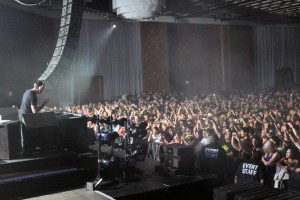
ATLANTIC CITY — A single spotlight lit a path
through the artificial fog of Mixx nightclub to the DJ booth where
Tijs Michiel Verwest stood, his glittery headphones shimmering in
the blue glow.
Behind him, massive screens flashing in sync with the pounding
bass displayed his better-known stage name: Tiesto.
It was the second of two sold-out shows at Borgata earlier this
month by the Dutch producer, who’s most often found globe-trotting
to play packed stadiums.
“This is the closest we’re ever going to get to Tiesto,” said
Paul Castro, of Atlantic City, a resident DJ at the club who was
equally enthralled as he watched from the second level.
The show capped a year that brought a lineup of world-class DJs
to Atlantic City as the popularity of electronic dance music surges
in the U.S.
“There are so many people who are really embracing it that never
did before,” said Gregg Coyle, director of nightlife for Borgata
Hotel Casino & Spa.
Seeing this trend, Borgata started its “I Love House” music
series earlier this year, “house” being the most popular style of
electronic music’s countless sub-genres.
So far, the promotions featured a variety of premier electronic
artists, including Tiesto, David Guetta, Deadmau5, Kaskade, Steve
Aoki, Steve Angello, Sebastian Ingrosso, Laidback Luke, ATB,
A-Trak, Dirty South and more.
Every show in the series has sold out. Tickets for Tiesto’s
performances, which were $75 each in advance, were selling online
for more than twice that amount.
But Borgata hasn’t been alone in bringing the world’s best disk
jockeys to its nightlife scene this year.
In May, Calvin Harris headlined a 14-hour, 30-act electronic
party at The Pool at Harrah’s Resort. Harris produced Rihanna’s hit
single “We Found Love,” a song that currently tops Billboard’s Top
100 chart.
In July, Skrillex, a DJ and producer recently nominated for five
Grammy awards including best new artist, performed at the House of
Blues.
And on Wednesday, The Pool also brought in Roger Sanchez, a
Grammy-winning and internationally renowned DJ and house producer
for its “Official House Beach Bash.”
For many of these artists, it was their first time in Atlantic
City. Only a handful of internationally famous DJs played here
prior to 2011, including Paul Oakenfold, Paul Van Dyk and Carl
Cox.
Mixing live
The shows, whether in a concert hall or a nightclub, are more
than the artists plugging in their iPods and loading a
playlist.
The best can seamlessly mix the music live, controlling the
speed and pitch, adding distortions and filters, and selecting
songs based on the energy of the crowd.
People in the industry attribute its recent success to a variety
of factors, leading among them a continued collaboration between
electronic artists such as David Guetta and mainstream pop acts
like The Black Eyed Peas and Usher.
Whatever the cause, the ability of popular DJs to draw crowds to
their live shows is undeniable.
Example: Tiesto’s newest music video, “Maximal Crazy,” shows him
performing at the Electric Daisy Carnival in Las Vegas this summer,
a festival of electronic DJs with an attendance of 230,000 people
over three days.
He also regularly performs in the summer at Privilege in Ibiza,
Spain, the largest nightclub in the world, with a capacity of
10,000.
By comparison, the capacity at Borgata’s Event Center is 3,200.
At Mixx it’s 732.“
As it relates to our customer base, these guys are extremely
loyal,” Coyle said. “They buy tickets way in advance, and they get
here first in line even if they have tickets. They’re so passionate
about what they do.”
Howard Weiss, the regional director of nightlife operations,
strategy and development for Caesars’ eastern division, said that
means some of the biggest names in the business can be expensive to
book. Some DJs making $40,000 a night last year are charging twice
that now, while the biggest make $150,000 or more for a
performance.
From his perspective, Atlantic City is actually just now
catching up to the scene’s meteoric rise.
“In Vegas about five years ago, it was popping in and out, but
it really started taking off in 2010,” he said. “This past year
really showed it could be steady.”
Always plugged in
Of course, that hasn’t stopped smaller clubs throughout the city
from fueling their dancing floor with house music. Lesser-known DJs
are armed with many of the same hits and remixes, and they work
them into their sets on a nightly basis.
This summer, The Chelsea Hotel worked with the
Philadelphia-based promotion company Art of Electronica to debut
“Delicious Sundays,” a weekly daytime party around its fifth story
rooftop pool with regionally-known house DJs.
“It used to be more underground, but I see it actually taking
over different clubs and getting larger,” Chelsea nightlife manager
Darryl Logan said about the genre. “No doubt about it.
”The hotel’s C5 nightclub also debuted “Euro Night” on Sundays
this past summer, featuring electronic music that’s big with
foreign crowds.
Similarly, Dusk nightclub at Caesars has made house music a
focus of the “Global Fridays” promotion it began in 2010. On
Tuesday, Dec. 20, singer John Martin will appear at the club and
perform “Save the World,” the Grammy-nominated hit song he recorded
with the DJ supergroup Swedish House Mafia.
Logan said the crowds that usually fill electronic shows are
out-of-towners, coming from New York, Philadelphia and Washington,
D.C., which Coyle and Weiss said is largely true of their shows as
well.
Todd Rodeghiero, who co-founded Art of Electronica last year,
said the city can easily attract electronic music fans from those
cities if they market events the right way.
“Atlantic City stays open all night, and you have a lot more to
do after the show,” he said. “At some point, New York shuts down,
whether you want it to or not.”
Rodeghiero and Coyle both said they have big acts planned for
2012, but declined to name names.“
I think 2012’s going to be the strongest year ever,” said Weiss,
who predicted that the new clubs at the Revel casino will focus on
the house music market.
DJ Paul Castro agreed. In August, he opened at Mixx for Kaskade,
who was recently voted America’s best DJ in a contest sponsored by
Pioneer DJ.
Castro started DJing in 1991, and he’s been a fan of house music
for a long time. Lately, he said he’s been getting a better crowd
response from house than a lot of the mashed-up hip-hop and pop
that dominated DJs’ playlists for years.
“I think this music has a lot more energy,” Castro said, “and I
think America is ready for it.”